
The agency attributed the sharp revision to various high-frequency indicators showing a softness and partly blamed the same to reforms like GST, real estate regulation, and the bankruptcy code which are still a "drag" on the economy.

India's exports contracted by 22 per cent, the steepest decline in the last three years, to $32.97 billion in June on account of global demand slowdown, especially in the Western markets like the US and Europe. According to the data of the commerce ministry, the trade deficit in June stood at $20.3 billion against $22.07 billion in the same month last year due to a fall in exports and imports. The inbound shipments during the month under review declined by a steep 17.48 per cent to $53.10 billion.

Over the past year, the National Stock Exchange Nifty FMCG Index, which tracks the market capitalisation of the top 15 companies in the fast-moving consumer goods (FMCG) sector, has surged by 17.3 per cent. In contrast, the Nifty50, a broader market index, has witnessed an 8.8 per cent increase during the same period. The FMCG stocks have also been rally leaders in the current calendar year.

Finance Minister Pranab Mukherjee today said the global slowdown will impact India's growth prospects, but expressed hope that inflation will start moderating from December.
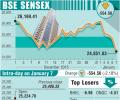
The S&P BSE Sensex plunged 555 points to end at 24,852.
To mitigate the impact of the economic slowdown on their businesses, a majority of Indian firms have implemented significant cost reductions and are reviewing their operational effectiveness, a PwC survey says.

Mukesh Ambani, who is in talks with Saudi Arabian oil giant Aramco to sell one-fifth of his oil-to-chemicals business in India for $ 15 billion, said the two countries have all factors to drive growth - technology, young demography, and leadership.

While most analysts are expecting poor results from oil marketing companies (OMCs) in the first quarter of 2024-25 (Q1FY25) and even in the first half (H1) of FY25, GAIL (India) could be an outlier. Upstream producers, Oil and Natural Gas Corporation (ONGC) and Oil India (OIL) could do well due to strong crude and gas prices, but refiners are likely to see weak margins and the impact of frozen prices during the election period will also be negative.

While edging up China's gross domestic product growth projection for both 2010 and 2011, the report said that growth in domestic demand would remain strong although exports could suffer from a predicted global economic slowdown next year.

The IPO market will be bustling next week, with four companies, including Bajaj Housing Finance, set to launch their initial share-sale to raise a total of Rs 8,390 crore. Besides these four main-board IPOs, nine SMEs are preparing to debut with their maiden public issues next week, targeting to collect Rs 254 crore. Together, these 13 firms are looking to raise Rs 8,644 crore through IPO.
The US and Europe account for about one-third of India's exports.

One million more go globe trotting in 2008-09.
As each month's economic numbers roll in, the slowdown gets more serious; and each month it gets clearer than before that government spokesmen who keep predicting an upturn are whistling in the dark.
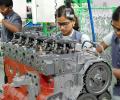
Genset manufacturer Cummins India has seen its share price rise by 45 per cent in the past three months. The management has reaffirmed that growth would be in double digits over the coming two fiscal years. Growth is expected to be driven by a pickup in domestic infrastructure spending.

Most analysts expect the note ban to sharply hit GVA growth in Q3 and Q4, and the central bank's stance is being called into question.

Consumer sentiments have been dampened due to several factors like tight liquidity, high insurance, and high costs
The town houses some 1,500 small and tiny units, of which 75 per cent are engaged in manufacturing components for the automotive industry. The town houses some 1,500 small and tiny units, of which 75 per cent are engaged in manufacturing components for the automotive industry.
As the global economic crisis unfolds, India expects further moderation in foreign capital flows and exports leading to slowdown in economy, minister of state for finance P K Bansal told the Rajya Sabha on Tuesday. Referring to the impact of crisis on the country, Bansal, to another query said, "Industrial activity, particularly in the manufacturing and infrastructure sectors, is decelerating."
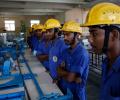
Unincorporated enterprises in the manufacturing sector lost nearly 1.8 million establishments and shed 5.4 million jobs between July 2015-June 2016 and October 2022-September 2023, an analysis of the fact sheet on 'Annual Survey of Unincorporated Sector Enterprises (ASUSE)' and the comparable 73rd round survey in 2015-16 by the National Statistical Office (NSO) showed. An estimated 17.82 million unincorporated enterprises operated in the manufacturing sector in October 2022-September 2023, nearly 9.3 per cent down from 19.7 million unincorporated enterprises in July 2015- June 2016.

Moody's said fiscal measures undertaken by the government -- such as corporate tax rate cuts, bank recapitalisation, infrastructure spending plans, support for the auto sector and others -- do not directly address widespread weakness in consumption demand, which has been the chief driver of the economy. In addition, interest rate cuts by the Reserve Bank of India are not being adequately transmitted to lending rates because of the credit squeeze caused by disruption in the non-bank financial sector, it said.

The central government is on track to meet its fiscal deficit target of 6.4 per cent of the GDP for 2022-23 on the back of strong growth in revenue collections, the World Bank said in its India Development Update on Tuesday. High nominal GDP growth in the first quarter supported strong growth in revenue collection, especially Goods and Services Tax (GST), despite tax cuts on fuel. Notwithstanding an increase in spending due to expanded fertilizer subsidies and food subsidies for vulnerable households in response to the commodity price shock, the government is on track to meet its FY22/23 fiscal deficit target of 6.4 per cent of GDP and the general government deficit is projected to decline to 9.6 per cent from 10.3 per cent in FY21/22 and 13.3 per cent in FY20/21.

Sector-wise, the study revealed that the core industries have witnessed virtually negative growth in headcount, with crude oil just about maintaining the employment level.
Domestic pharmaceutical market registered a value growth of 14.4 per cent in January and 9.9 per cent in the 12 months ended January 2009. The yearly turnover was Rs 34,487.17 crore. The growth of the domestic drug sector, which was just 6.8 per cent in November 2008, improved to 13.2 per cent in December and to 14.4 per cent this January.
Consumer goods firms and auto companies are witnessing an upturn in rural demand, which had been lagging for most of FY24. Expectations of a bumper rabi crop harvest have helped turn the tide. The Reserve Bank of India's (RBI's) Monetary Policy Committee kept the repo rate unchanged last week, noting that as rural demand catches up, consumption is expected to support economic growth in 2024-25.

From auto to watches, the mood is sombre due to the alarming state of the Indian economy and value erosion in stock market capitalisation.

China's post COVID-19 pandemic economic rebound showed signs of slowdown as the economy grew at 7.9 per cent in the second quarter compared to a record 18.3 per cent in Q1, while the GDP expanded 12.7 per cent year on year in the first half amid the continued global spread of the coronavirus and unbalanced domestic recovery. In the second quarter, the GDP of the second largest economy in the world grew 7.9 per cent year on year, the data released by the National Bureau of Statistics, (NBS) on Thursday showed. On a quarterly basis, the economy expanded 1.3 per cent in Q2.
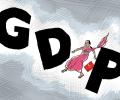
Fitch reaffirmed India's rating at 'BBB-' with a Stable Outlook saying the rating balances a still strong medium-term growth outlook compared with similar category peers and relative external resilience stemming from solid foreign-reserve buffers against high public debt, a weak financial sector and some lagging structural factors, including governance indicators and GDP per capita.
The economic growth could slow down to 7.8 per cent in 2008 from over 9 per cent currently due to policy bottlenecks resulting in deceleration in investment growth in the country, says a World Bank report.
While China continues to be the largest engine for growth in Asia, other parts of the region were also seeing significant increases in demand for travel with a fast-expanding middle class providing a 'brighter outlook' for Asian carriers, the latest study by the Association of Asia Pacific Airlines has said.

Info Edge (India) reported a good fourth quarter for the 2022-23 financial year (Q4FY23) given depressed conditions in the Key IT segment. The billing growth of 13.7 per cent year-on-year (YoY) in recruitment was well ahead of market expectations. There was solid growth in realisations (up 5.5 per cent) as well as unique customers (up 7.7 per cent).

The economy could grow at 6-6.5 per cent this fiscal year (2019-20 or FY20), said Chief Economic Advisor Krishnamurthy Subramanian, revising his earlier estimate of 7 per cent in the Economic Survey. In an interaction with Arup Roychoudhury, he said supply-side measures, including corporation tax cuts, will boost consumption and demand, and non-tax revenue may make up for shortfall in tax revenues.

To minimise risk, invest in a debt fund whose duration matches your investment timeframe.

The former RBI deputy governor talked about the prospects of an economic revival, reforms in IMF, etc.
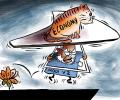
India's growth outlook has weakened sharply this year, with a crunch that started with the non-banking finance institutions spreading to retail businesses, car-makers, home sales and heavy industries.
The specific characteristics of the Indian growth slowdown are poised, according to some observers, to stall a major structural change to the Indian economy.

Asked when the economy will revive, Das said it is difficult to make an estimate as there are many things which are still playing out.

Analyst are cautious about the performance of IT services sector from January to March quarter (Q4) of FY24 and the first half (H1) of FY25. While the Bloomberg consensus on revenue implies the market is expecting 2-3 per cent growth on a quarter-on-quarter (Q-o-Q) basis for the IT majors through FY25, the H1FY25 is likely to see even flatter returns, and Q4FY24 is likely to be poor. There is likely to be some recovery in the second half (H2FY25) but even so, there's a chance that the market will be overall disappointed.

The slowdown in India is related to a credit squeeze, which is a cyclical problem - not a structural problem: American economist Steve Hanke.

Nearly 40 per cent of IITians sitting for placements in 2024 are yet to receive job offers, showing a doubling of the 'unplaced' in the last three years from 19 per cent in 2021-2022 to 38 per cent in 2023-2024.

Private equity (PE) investments in India have fallen to a 6-year low at $24.2 billion in the financial year ending March 2024. Investments via PE deals are down 47 per cent compared to FY23, when private equity deals worth $45.8 billion were signed. According to data sourced from Bloomberg, PE firms had signed record deals worth $80 billion in the financial year ending March 2022.
